By Hasib Bashirzay 30432138
I’m going to discuss Hooke’s law of elasticity in today’s blog and go through an experiment I’ve done at university on Hooke’s law. I hope you find this blog interesting, useful and beneficial so that it can be used to help you understand Hooke’s law and/ or refer to this blog when the time comes for you to do your own Hooke’s law test.
Before going through Hooke’s law and what it actually is, I would just like to give you some information about the man behind this.
Robert Hooke
Robert Hooke was a man of many trades who is mostly known for being a scientist, natural philosopher and an architect. He had achieved many great things in his life such as originating the word ‘cell’ in biology, inventing the balance wheel on a watch and co-designing a monument commemorating ‘The Great Fire of London’ with his fellow architect Christopher Wren. Don’t forget to visit this the next time you’re in the city of London!


Image 1: Robert Hooke [1] Image 2: Monument design [2]
His greatest discovery however, for what he is known, is the Hooke’s law of elasticity.
Introduction to Hooke’s Law
This law simply states that the force applied to an elastic material is directly proportional to the extension of the material until the material has exceeded its limit of proportionality. To break this down, if a tensile (stretching) force, F, is applied to a spring of natural length l, the extension of the spring, ∆l, is given by ∆l =F/k or F = k∆l where k is the spring constant.
F = kx where F = force applied on the spring, k = spring constant and x = extension of the spring.
Hooke’s law experiment
The experiment that I carried out at university involved looking at the behaviour of three different elastic materials; ‘y1’, ‘y2’ and ‘z’ when undergoing deformation due to a tensile force ‘x’. The experiment was set up in the same way you can see in the picture below and the results were then tabulated.


Results collected from experiment Experiment set up
I then plotted the results of y1 and y2 on the same graph

From the graph above, ‘y1’ and ‘y2’ are both appearing to follow Hooke’s law as both y1 and y2 are showing a direct proportionality between the force ‘x’ applied and the deformation. Therefore we can say that both materials are still within their elastic region and we can see two straight line graphs where y1 and y2 are intercepting. By solving both lines’ equations simulutaneously, I found the point of interception to be (2.35, 5.04).
I then plotted a separate graph for material ‘z’
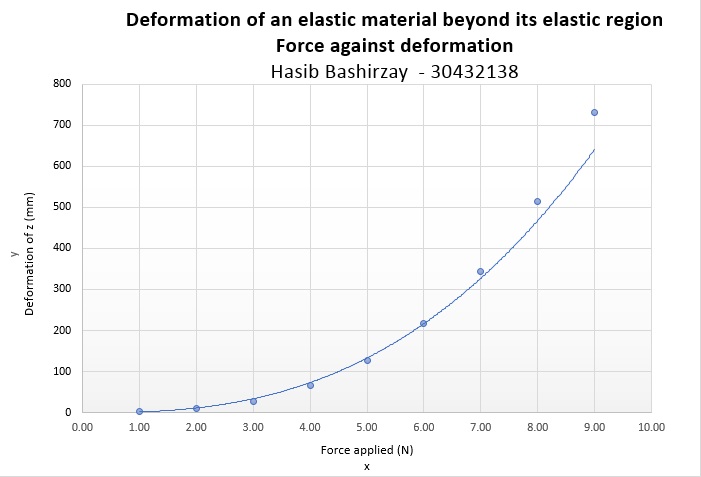
Now material ‘z’ seems to have gone beyond its elastic region and has gone into the plastic region. This can be seen in the exponential graph from when x is beyond 3. From when x=1 to x=3 we could draw a straight line to show the direct proportionality when the material was still within its elastic region. But after that we can see the great difference in the deformation and the material going beyond its elastic region to its plastic region.
Based on the results of this experiment, I can conclude that Hooke’s Law of elasticity holds validity as my experiment reciprocated the concept of the law – as I increased the the force ‘x’ applied onto materials ‘y1’ and ‘y2’ the deformation of the materials increased proportionally.
We can see in the first graph that there was a source of error with ‘y1’ when it was loaded with 7 N of Force as the trend line does not fit into it just like it does with all the other points. This may have been due to human errors when I was checking the deformation of the material when 7 N were applied to it. Perhaps the deformation may not have been measured from the beginning of the material and therefore resulted me in finding a higher number for the deformation of the material at that set force.
References:
https://www.historic-uk.com/HistoryUK/HistoryofEngland/Dr-Robert-Hooke/
http://www.roberthooke.org.uk/
Robert Hooke
 HB's Hooke's Law Blog